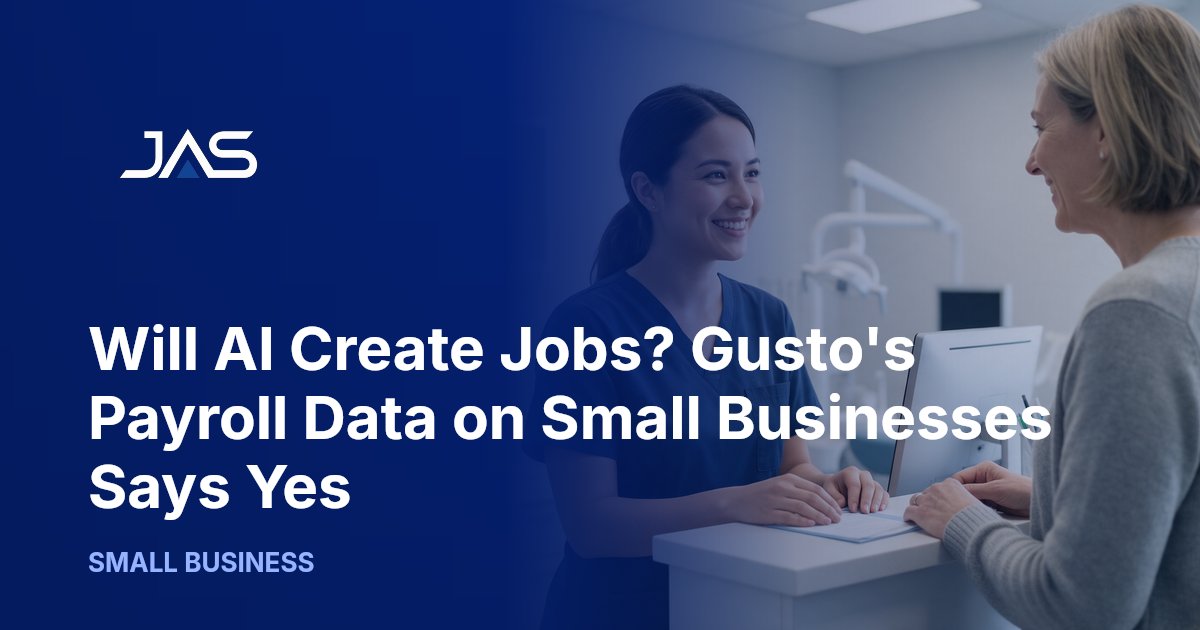
Will AI Create Jobs? Gusto's Payroll Data on Small Businesses Says Yes
Gusto tracked the payroll of small businesses that adopted AI. A year later they had hired more than comparable firms that had not, and the new hires were hands-on roles.
Quick answer
For small businesses, early evidence says yes. Gusto's payroll data on 1,593 AI adopters and 669 non-adopters found adopters grew headcount about 7% more in the year after adopting, about 10% more for firms under ten employees. The new hires were mostly hands-on, customer-facing roles rather than technical ones.
Will AI create jobs or destroy them? Most of the public evidence so far comes from large companies announcing cuts. Gusto, which runs payroll for small businesses, looked at the question from the other end, using what employers actually paid people rather than what they said they planned to do.
What Gusto measured
Gusto published the research on 10 September 2026. It followed businesses that answered its 2025 "Main Street Meets Machine Learning" survey, then used real payroll records to see how their teams changed over the next year.
- 1,593 small businesses that had adopted AI.
- 669 small businesses that were aware of AI but had not adopted it.
- Headcount tracked for the year after adoption, using payroll data.
Did AI-adopting small businesses hire more?
Yes. Businesses that adopted AI grew headcount about 7% more than comparable non-adopters in the year after adoption. The gap widened steadily, from about 4.5% to 6.8% by the end of the fourth quarter.
| Group | Extra growth after one year |
|---|---|
| All small businesses | About 7% |
| Fewer than 10 employees | About 10% |
| Health care and social assistance, fewer than 10 employees | Nearly 20% |
Gusto economist Nich Tremper put it directly: "This data pushes back on the idea that AI is coming for jobs on Main Street."
Who got hired
The detail that stands out is the type of role. New hires were mostly hands-on and customer-facing: teachers, technicians, cooks, front desk and admin support, and care providers such as dental hygienists and therapists.
These are not AI jobs. They are the jobs a small business adds when it can take on more customers.
Why would small businesses hire when big companies cut?
Large and small companies start from different places.
A large company has layers of coordination, reporting and support. AI gives it a reason to examine and remove some of them. We looked at that pattern in Uber's manager cuts.
A ten-person business usually has no such layer. The owner and a few staff do everything, including the admin nobody was hired for. When software absorbs scheduling, follow-ups, invoicing or first-draft paperwork, there is nobody to cut. What appears instead is time, and time lets the business serve more customers, which requires more hands.
| Large company | Small business | |
|---|---|---|
| Starting point | Existing layers of support work | No slack, owner does the admin |
| What AI removes | Roles in those layers | Hours of unpaid admin |
| What the savings buy | Margin and shareholder returns | Capacity to take on more customers |
| Headcount effect | Down | Up |
The fair caveat
Studies like this face a selection question. The businesses organized enough to adopt AI early might have been growing faster anyway, and a comparison between adopters and non-adopters can struggle to fully separate the two effects.
That caveat is worth keeping. It is also worth noticing that the same caution is rarely applied to layoff headlines, where a company naming AI as a reason is usually taken at face value. Evidence should be weighed the same way in both directions.
What this means if you run a small business
The practical takeaway is not "adopt AI and you will hire." It is about what you do with the time AI frees.
- Start with the admin you do at night. The biggest gains for small teams come from removing unpaid owner work: scheduling, follow-ups, quoting, first-draft documents. Process automation is usually the right first step, not a chatbot.
- Decide in advance what the time is for. If freed hours simply disappear into more of the same, nothing changes. If they go into serving more customers, the business grows.
- Hire for the work only people can do. The roles Gusto's adopters added were hands-on and customer-facing. That is where small businesses keep their edge.
For small businesses, the most useful way to see AI may be as the thing that lets you afford the next hire, rather than the thing that replaces the last one.
Frequently asked questions
- Does AI create jobs at small businesses?
- In Gusto's September 2026 research, small businesses that adopted AI grew headcount about 7% more than comparable non-adopters over the following year. The gap rose from about 4.5% to 6.8% by the fourth quarter.
- What kinds of jobs did AI-adopting small businesses add?
- Mostly hands-on, customer-facing roles such as teachers, technicians, cooks, front desk staff, admin support and care providers, not AI or technical positions.
- Which small businesses saw the biggest hiring gains?
- The smallest. Firms with fewer than ten employees grew about 10% more than comparable non-adopters, and small health care and social assistance practices grew nearly 20% more.
- Does this prove AI causes hiring?
- Not on its own. Businesses that adopt new tools early may already be on a growth path. The data is strong evidence that AI adoption and hiring go together at small firms, and it runs against the assumption that AI shrinks small business payrolls.